
Peptide Calculator — Reconstitution Math Made Simple
Stuck on vial math? This free tool turns your numbers into concentration, draw volume, and syringe units in seconds — no signup, no sales pitch.
Your inputs
Results
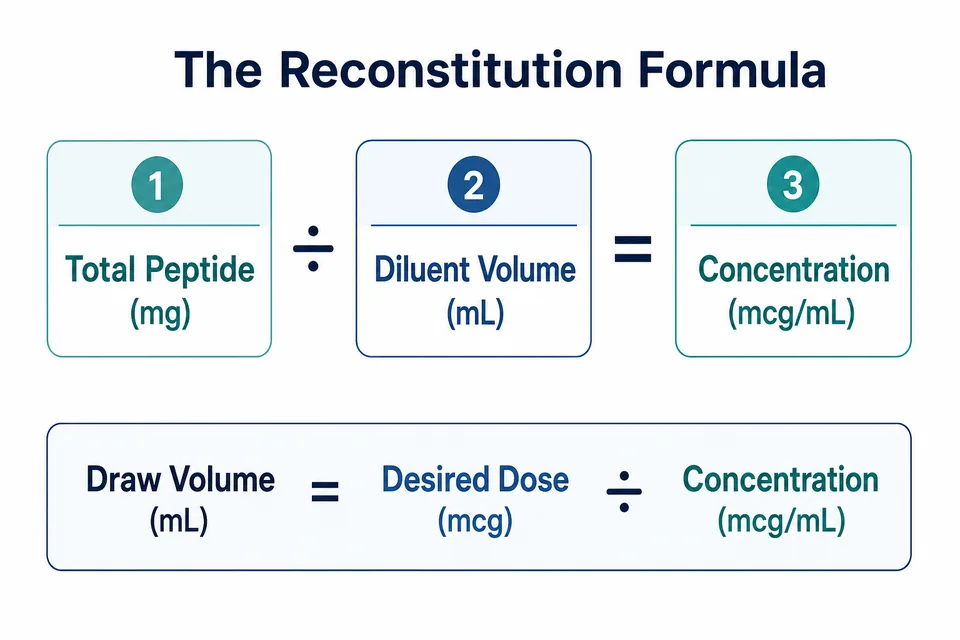
Draw Volume = Desired Dose ÷ Concentration
Peptide calculator math looks scary until you see the pattern. You have a dry vial. You added water. Now you need syringe units. That is the whole problem this page solves — right now, for free.
Most people land here with the same headache. They know their vial size. They know how much bacteriostatic water went in. They have a dose figure from a label or protocol. What they lack is the bridge from mg to mL to units. Here is what I will show you: the formula, the units, the steps, and the traps that waste a whole vial.
What Is a Peptide Calculator?
A peptide reconstitution calculator is a math tool for freeze-dried vials. You type three things: vial amount, water volume, and a dose value. You get concentration, mL to draw, and insulin syringe units.
It also works as a peptide dosage calculator or peptide mixing calculator — same math, different name. The truth is, the division is easy. Keeping mg, mcg, mL, and units straight is the hard part.
One wrong toggle and your draw is off by 1,000×. This peptide dose calculator will not pick a dose for you. It only converts numbers you already have.
How the math works
Lyophilized powder dissolves evenly in liquid. Every mL holds the same share of the original vial mass. That fixed ratio is what a peptide concentration calculator locks in after you mix.
What Is Peptide Reconstitution?
Reconstitution means adding liquid to dry peptide powder. Most vials ship as lyophilized powder. Until you mix, there is no mL to measure. No concentration exists yet.
A 5 mg vial on the shelf has mass but no volume. Add bacteriostatic water and you get a solution you can draw. That is step one. Step two is dose math — and that is where this tool lives.
Mixing and calculating are separate jobs. The peptide calculator never tells you what dose to use. It only converts a dose you enter into volume and units.
How to Use This Peptide Calculator
Four steps. Results update live. No button to click. Here is the simple step-by-step method.
- Enter vial amount. Use the mg on the label. Switch to mcg if needed. This is total vial content — not one draw.
- Enter diluent volume. Type the mL of bacteriostatic water you added. This drives every peptide BAC water calculator equation.
- Enter your dose value. Math input only. The peptide units calculator does not suggest what to type.
- Read your results. Check concentration, draw mL, units, and doses per vial. The fill bar shows your mark on the barrel.
How Peptide Dosage Is Calculated
Every peptide mg to mL conversion uses three equations. Write them once. You can check any output by hand.
| Step | Formula | You get |
|---|---|---|
| 1 | Total peptide (mcg) ÷ Diluent (mL) | mcg/mL |
| 2 | Dose (mcg) ÷ Concentration (mcg/mL) | Draw mL |
| 3 | Draw mL × Units per mL | Syringe units |
Divide mcg/mL by 1,000 to get mg/mL. Labels often show mg. Dose fields often use mcg. Know which unit is active before you enter anything.
Doses per vial
Total vial mcg divided by dose mcg gives doses per vial. Round down. A 5 mg vial holds 5,000 mcg. At 250 mcg input, you get 20 draws on paper.
Understanding Concentration, mg, mcg, and mL
Four units. One mistake ruins the whole draw. Here is what each one means.
- mg — vial labels usually show milligrams. 5 mg = 5,000 mcg.
- mcg — dose entries often use micrograms. 250 mcg = 0.25 mg.
- mL — liquid volume. You always convert to mL before you get units.
- Concentration — mass per volume. Your dilution ratio as one number.
The mg vs mcg trap
1 mg = 1,000 mcg. Type 250 as mg when you mean mcg and every result jumps 1,000×. Check the unit toggle every single time.
Why you cannot skip concentration
mcg is mass. mL is volume. You need concentration (mcg/mL) to bridge them. That is why any peptide concentration calculator asks for vial size and water volume first.
| From | To | Do this |
|---|---|---|
| mg | mcg | × 1,000 |
| mcg | mg | ÷ 1,000 |
| mL | U-100 units | × 100 |
| 1 U-100 unit | mL | × 0.01 |
Bacteriostatic Water and Diluent Volume
Bacteriostatic water is sterile water plus 0.9% benzyl alcohol. The preservative slows bacteria growth. Multi-dose vials often use it instead of plain sterile water.
For math, the diluent name does not matter. Only the mL count matters. That volume sits at the bottom of your concentration equation.
BAC water vs sterile water vs saline
- Bacteriostatic water — common for vials you open more than once.
- Sterile water — no preservative. Often single-use. Same math if you log the mL.
- Saline — some labels call for it. Again, mL drives the math.
Follow your product label for diluent choice. The tool only needs volume in mL.
How much water should you add?
More water = lower concentration = more units for the same dose input. Less water = the opposite. Pick a volume that gives a draw you can read on your syringe. Then type that mL into the tool.
Under 5 units on U-100? The math may be fine but the mark is tiny. Re-run with more water to see how units shift. That is a measurement call — not advice from this page.
Syringe Units Explained
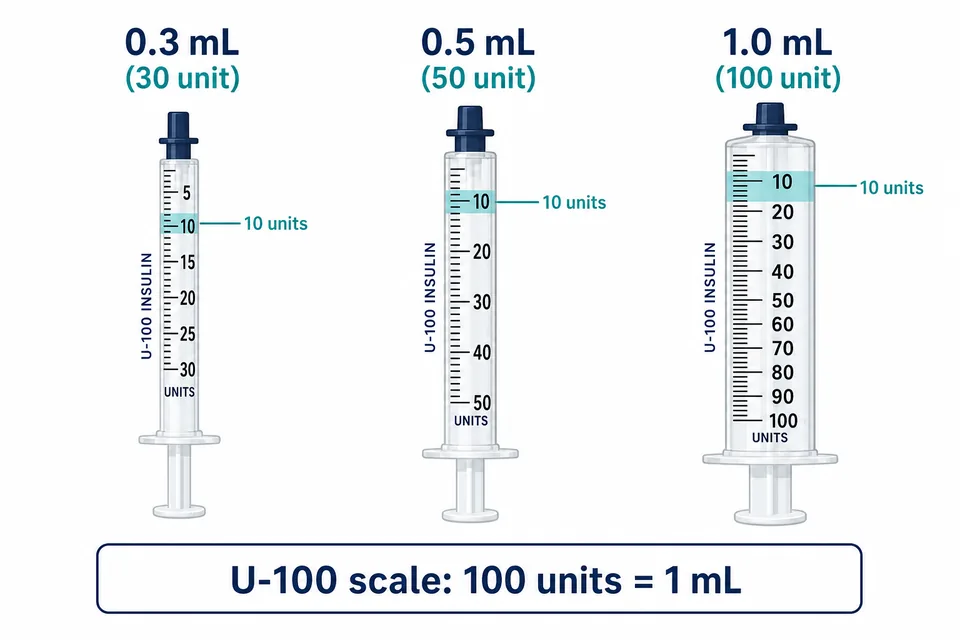
A peptide syringe calculator turns mL into barrel marks. On U-100, 100 units = 1 mL. One unit = 0.01 mL.
Barrel size — 0.3, 0.5, or 1.0 mL — sets capacity only. Ten units is always 0.10 mL on U-100. A smaller barrel spreads those ten units over more length.
Match your syringe scale
U-50 gives 50 units per mL. U-40 gives 40. Use U-100 math on a U-40 barrel and your draw is wrong. Set the correct scale first.
Reading the barrel
Find the numbered ticks. On U-100, each small line is usually 1 unit. Draw to the line that matches your result — at the liquid edge, not the plunger top.
How to Read a Vial Label
Your label feeds every input field. Check these before you type.
- Total mg or mcg — your vial amount field.
- Lyophilized / freeze-dried — powder before mixing. No concentration yet.
- Storage notes — handling info, not calculator math.
- Reconstitution notes — product docs may suggest a water volume.
After mixing, write the date, water mL, and concentration on the vial. Future math depends on accurate inputs.
What Your Results Mean
- Concentration — peptide mass per mL after mixing.
- Draw volume — mL that holds your entered dose.
- Syringe units — the tick mark on your barrel.
- mcg per unit — quick sanity check number.
- Doses per vial — how many times your dose input fits in the vial.
Overflow warning means your draw exceeds barrel size. Change water mL or pick a bigger barrel. That is math tuning — not a recommendation.
Why More Water Changes Units but Not Peptide Mass
Here is the thing most people miss. The vial always holds the same total peptide. Water only changes how that mass spreads through liquid.
5 mg plus 1 mL = 5,000 mcg/mL. Same vial plus 2 mL = 2,500 mcg/mL. Total peptide did not move. At 250 mcg input, units go from 5 to 10 on U-100.
More water never adds peptide. It thins the mix. A peptide mixing calculator always needs the mL you actually used — not a guess.
Reconstitution Steps — General Lab Reference
Warning: Lab handling info only. Not medical instruction. Follow your product label.
- Clean your workspace. Wash hands. Gloves if your protocol says so.
- Bring vials to room temp. Cold powder dissolves slower.
- Swab both stoppers with alcohol before you puncture.
- Draw diluent first. Pull your planned mL before you touch the peptide vial.
- Add water slowly down the vial wall. Do not blast the powder.
- Swirl gently. Never shake. Foam ruins draw accuracy.
- Log your inputs. Vial mg, water mL, and concentration from the tool.
Worked Examples — Math Only
Neutral arithmetic. Not dosing guidance. Use these to check the tool.
5 mg vial + 2 mL water + 250 mcg input
5,000 mcg ÷ 2 mL = 2,500 mcg/mL
250 ÷ 2,500 = 0.1 mL = 10 units on U-100
10 mg vial + 1 mL water + 500 mcg input
10,000 mcg ÷ 1 mL = 10,000 mcg/mL
500 ÷ 10,000 = 0.05 mL = 5 units on U-100
Same vial, different water
5 mg + 1 mL → 250 mcg input = 5 units
5 mg + 2 mL → same input = 10 units. Same peptide. Different mark.
Quick Reference Table
Fixed 250 mcg input on U-100. Cross-check only — run the peptide calculator above with your own dose to get exact numbers.
| Vial | Water | Concentration | Draw | Units |
|---|---|---|---|---|
| 2 mg | 2 mL | 1,000 mcg/mL | 0.25 mL | 25 |
| 5 mg | 2 mL | 2,500 mcg/mL | 0.10 mL | 10 |
| 5 mg | 1 mL | 5,000 mcg/mL | 0.05 mL | 5 |
| 10 mg | 2 mL | 5,000 mcg/mL | 0.05 mL | 5 |
| 10 mg | 3 mL | 3,333 mcg/mL | 0.075 mL | 7.5 |
Common Mistakes That Ruin Your Math
The biggest mistake people make is swapping mg and mcg. A peptide calculator cannot fix bad inputs — garbage in, garbage out.
- mg/mcg swap — 1,000× error. Check the toggle.
- Wrong U-scale — U-100 vs U-50 vs U-40. Match your barrel.
- Wrong vial number — enter total vial content, not one draw.
- Old concentration — re-run after every new mix.
- Barrel too small — overflow means the draw exceeds capacity.
- Unreadable tiny draws — under 5 units is hard to measure.
- IU vs mg — IU is for HGH activity, not mass. This tool uses mg and mcg only.
Storage and Handling Basics
General reference only. Follow your product label or COA for compound-specific rules.
Before mixing
- Store cold if the label says so. Many powders hold at −20 °C for months.
- Keep sealed vials away from light and moisture.
After mixing
- Refrigerate at 2–8 °C for most BAC-water mixes in multi-dose vials.
- Label with date, water mL, and concentration.
- Swirl to dissolve. Do not shake.
- Avoid repeat freeze-thaw cycles.
Storage does not change the formula. It affects how long your numbers stay valid.
Peptide Calculator FAQ
-
How do I convert mg to mL for a peptide?
Divide vial mcg by water mL to get concentration. Divide dose mcg by concentration. That is your draw in mL.
Multiply by 100 for U-100 units. Or use the tool above — it runs all three steps live.
-
What is the peptide reconstitution formula?
Concentration = amount ÷ volume. Draw = dose ÷ concentration. Units = draw × units per mL.
Same three lines every time for standard aqueous mixes.
-
How much bacteriostatic water should I add?
No single answer exists. More mL lowers concentration and raises units for the same dose.
Pick a volume that gives a readable syringe mark. Enter that mL in the calculator.
-
Why does adding more water change syringe units?
The vial mass stays fixed. More water spreads it through more liquid.
Same dose input then needs a larger draw and a higher unit count.
-
How many syringe units equal 1 mL?
100 units on U-100. 50 on U-50. 40 on U-40.
Read the scale on your syringe. Match it in the tool before you trust the output.
-
Is this peptide calculator medical advice?
No. It runs standard math on your inputs. It does not recommend doses or substances.
See our Medical Disclaimer. Talk to a licensed professional for medical calls.
Conclusion. You came here with a vial, some water, and a dose figure that needed translating. A peptide calculator does that in seconds — concentration, mL, units, doses per vial. Run yours above, check the formula by hand, and leave protocol calls to a qualified professional.
Last updated: July 9, 2026. Methodology follows standard pharmaceutical compounding math. See About for how this tool works. Not medical advice.